

When 17-year-old Natasha Taonga Phiri from Zambia, stood at the 4th African Girls’ Summit in November 2025 in Addis Ababa, Ethiopia, she did not speak in abstract terms about African girls. She spoke as a girl who has carried the weight of culture, felt the fear of harmful practices and discovered the power of being truly heard.
“Child marriage is not culture. It is violence,” she reminded the room. “Change often starts with one difficult conversation at home.”
The African Girls’ Summit brought together government representatives, civil society, partners and young people to tackle tough issues like Female genital mutilation, child marriage, gender-based violence and barriers to health and education. Under the theme “Building Innovations: Collectively Accelerating Girls’ Social Rights and Empowerment,” it sent a clear message: real change happens when girls are at the centre of decision-making, not just mentioned in speeches.
On a panel about practical ways to shift tradition and culture to eliminate harmful practices, Natasha brought this principle to life. She named practices like labia elongation (“kudonsa”), child marriage and defilement, grounding them in personal experience and stories from her community. She spoke honestly about how culture can provide identity and belonging, but also how it can be distorted to control or harm girls. For many in the room, it was a rare and powerful moment: a girl calmly unpacking issues usually whispered about, if mentioned at all.
Natasha reflects how the Trusts’ Pan African Adolescent Girls’ Movement works recognises them as co-creators of change. When girls are trusted with real responsibility, they bring clarity, courage and lived experience that adults often miss.
On the panel, Natasha described what it looks like when harmful practices are normalised in the name of culture, when silence protects perpetrators more than children, and how one girl asking a question or saying “no” can change the conversation at home.
She reminded participants that ending harmful practices requires more than statements of intent. “We must not sugar-coat what is hurting us,” she said. “If we are serious about ending harmful practices, we have to call them what they are and keep talking about them in our homes, schools and communities.”
GMT’s Programme= Coordinator, Catherine M’seteka, joined a separate panel and reflected on what this moment represents for the continent: a renewed commitment to an Africa where every girl is protected, heard and able to lead.
Over three days, Natasha and other adolescent “eagles” listened to stories of chiefs cancelling child marriages, governments enforcing stronger laws, and movements pushing back against attacks on girls’ rights. They also heard hard statistics about how many girls are still affected by FGM, child marriage and other forms of violence.
The Summit left Natasha both hopeful and determined. “I saw what is possible when laws are made and communities mobilise around girls’ rights. I was also reminded how far there is still to go before every girl can grow up safe, supported and free from harm. She left Addis Ababa feeling, in her own words, “fired up, encouraged and equipped.”
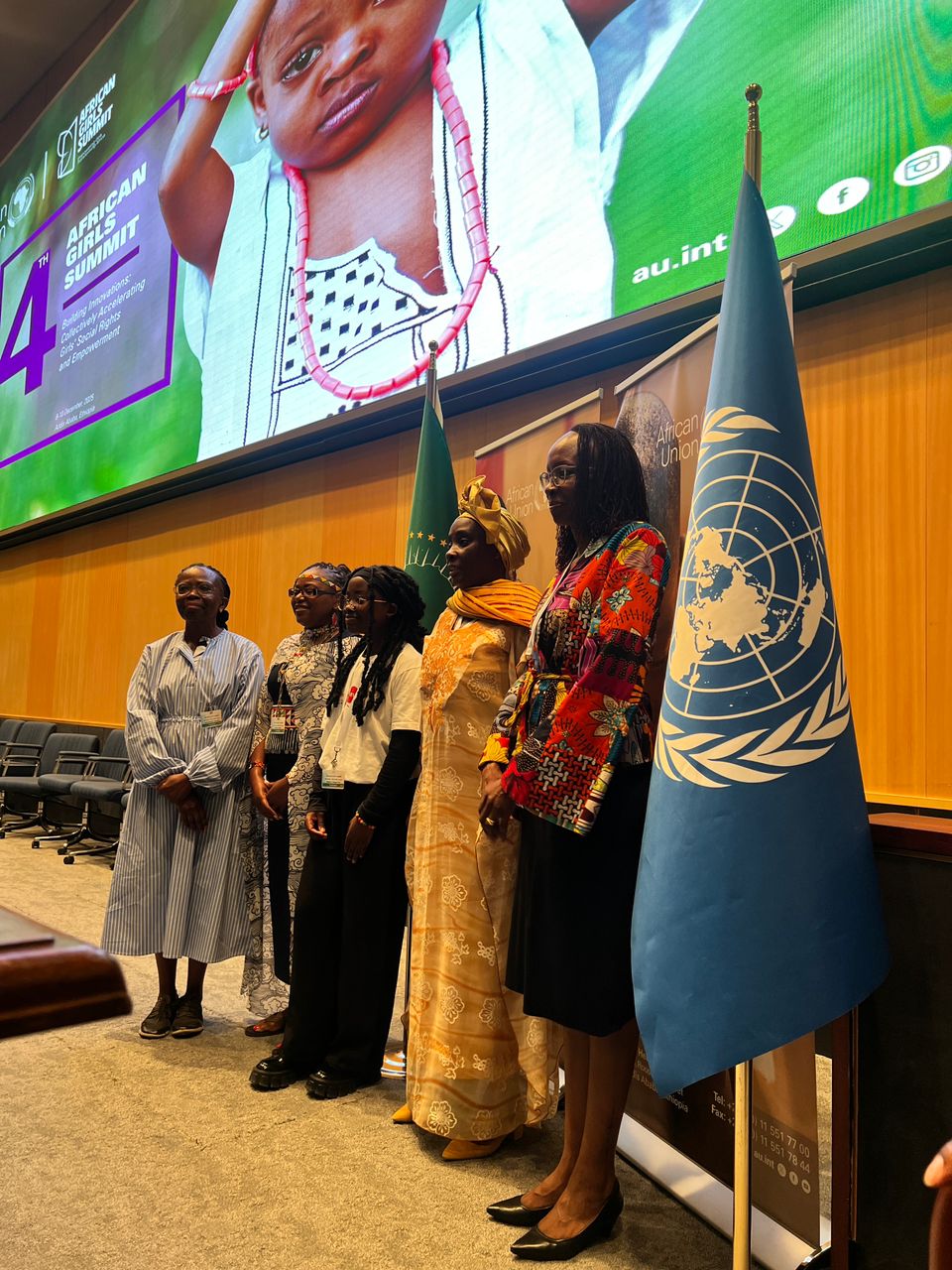
Natasha Taonga Phiri pictured with leaders at the summit where she spoke about harmful practices during a panel at the 4th African Girls’ Summit, Addis Ababa, Ethiopia (November 2025).